1: Entering the land
After a 10-hour drive south to Westmoreland, Tennessee, accompanied by six other young adults, an engineer, a lumber man and a Catholic priest, we arrived in good form, ready for whatever was to come on our mission. I had no idea what to expect, never having been on a mission trip before and never having been in the South. Every bend seemed a mystery and every mountain full of expectation. It would be necessary that I trade a spirit of fear for a spirit of poverty, as a mouse scampered through the kitchen lodge where I washed dishes and after meeting bugs and spiders five times the size they are in Wisconsin, I prayed they weren’t in our room – or worse, in our bunk beds! Traveling teaches you poverty, I realized. It unbinds you from pre-conceived notions about how things should be and growing too familiar in your ways. Stripped of extras in my life, I began seeing my soul in greater clarity. Just as I left behind the more frivolous material goods in my life, so I found myself letting go of worries and cares and comforts of every day, home life in order to embrace something new and be enriched by it. I felt, on the first traveling day, the loss of things left behind and a bit of in trepidation as I faced the unknown.
2: Of Guns and Stories
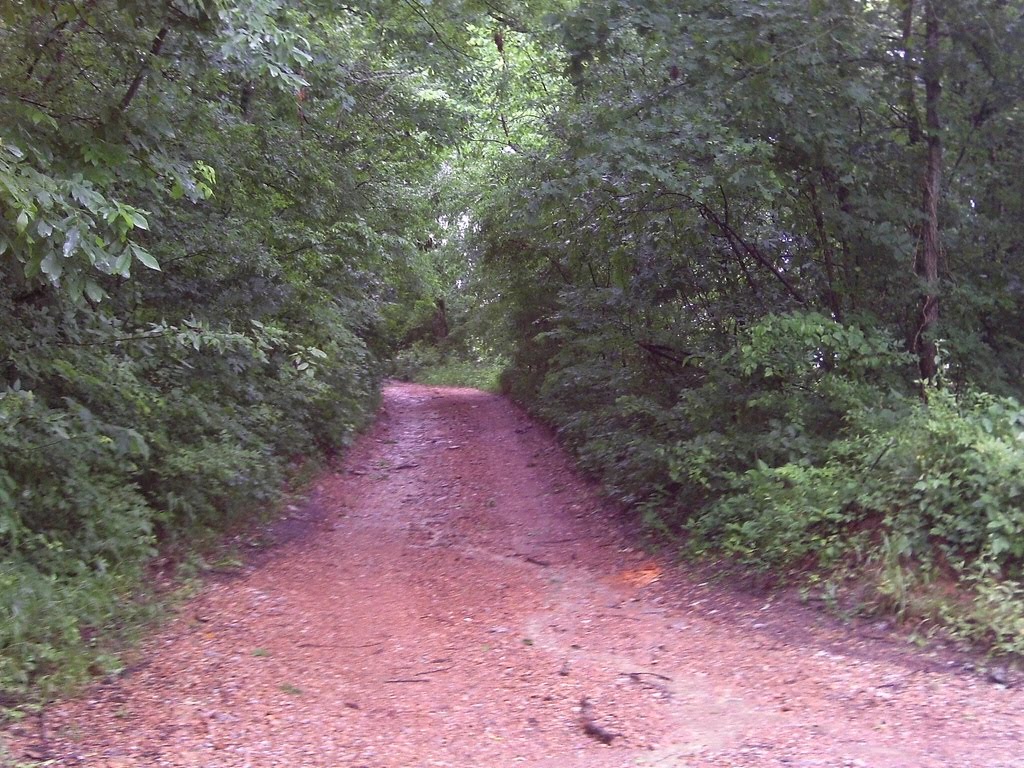
The woods in Tennessee are dense. Lush green brush grows up around the feet of the trees so that you cannot see the way through them. I wonder what is lurking behind the trees, over the hills and around the bends in the road. What was this country like when Indians quietly stole through these woods and surprised pilgrims, their curious and fearful eyes peering at them, and when the sound of war whoops pierced the silence and violence prevailed? I can't help but imagine it, as I read The Last of the Mohicans by Cooper.
I think of Flannery O’Connor, that southern woman writer, who wrote about the prejudices prevailing in the South, and through “large and startling figures” illumined how grace moves and works in our lives, sometimes in violent ways.
I wonder if my friend’s words about so much weaponry in the South might be true: “You might enjoy the South, where even girls like guns.” In fact, there is a gun shop just down the road from our camp. Flannery’s descriptions of the South are starting to make sense…or am I just fantasizing?
3: God’s Work

The sounds of hundreds of cicadas screaming in the trees overhead while we work crescendos and then fades, crescendos, then fades. We are kept company by chickens in the yard, which Betty pointed out, control the tick population. Also strolling around the property are three dogs, a few ducks, and a rooster that crows at intervals, every time the sun shines, announcing it as though his whole existence depended on it and the world had deaf ears. Flannery would have enjoyed this rooster and, perhaps, typified it as some sort of rejected preacher in this Christ-haunted South, still crowing out judgments. “Before the cock crows, you will deny me three times,” said our Lord to Peter.

Doug tells us about a black minister who lived in a little cabin in these woods and used to preach to the trees. He walked us to the cabin that has fallen apart, a wreck now in the woods, sitting there rotting away.
“This shed, this porch that we are now building up will one day be in ruins in just the same way. But what will last, what will endure, is the love with which we build it,” said Father Nathan, when we gathered for prayer at the end of the evening.
“Unless the Lord build the house, in vain do its laborers toil. Unless the Lord guard the city, in vain does the guard keep watch. It is vain for you to rise early and go to bed late, to eat bread earned by hard toil – all this God gives to his beloved while they slumber” (Ps. 127).
I’m learning how to saw 2x4s, build a wall, hammer nails, work with my hands and be useful, as well as how to take time out to listen and make conversation with Doug and Betty, who are benefiting from our mission work.


Waiting…each day we wait for instruction, wait for each other’s assistance, wait because of the rain or wait with Doug and Betty. As the days pass, I struggle to slow down, as I realize how fast-working and industrious we northerners are. Slowing down was hard. Sitting in conversation was hard when I knew the many tasks we had to complete. Yet, all of us agreed by the end of the mission that the projects we had finished had been God’s work. He was in charge and accomplished in us the work He wanted done in His name. What was left incomplete was for the next missionaries.
 I left feeling much like the unfinished shed and rough on the edges. God was building each one of us into His house and He wasn’t finished with me yet. This experience was one of the ways I was being built up and more would come.
4: Mountain music
Doug, a bluegrass and gospel musician who’d played with Johnny Cash and other notorious musicians in his lifetime, played for us on his mandolin, fiddle and guitar. He shared with us some of his recorded music and lots of stories, funny and sad, told in his low drawl.
His wife Betty had been through hard times, too. She told me, “It was by the grace of God” that she’d survived the cruel neglect and homelessness of her childhood years and a dysfunctional family to become the loving woman she is today. Talking about enmity in the family, Betty said, “When you let that hatred in, it just gives the devil more power, and he don’t need no more power!”
Betty could say this because she recognized and confronted the evil that plagued her life. She responded by seeking God’s grace. The action of grace in a person’s life is the theme of all Flannery O'Connor's stories: the acceptance or rejection of God’s grace by each character.
Betty is a red-head like me, sweet and loving, with a heart for helping others. I reminded her of an old friend she knew when she worked in a nursing home. I just hope that I can be as humble and enduring as she, of whom songwriter Harry Chapin might have wrote, “It’s what’s inside a woman when she’s up against the land.”
5: My cup runneth over

This picture brings it all back: quiet nights spent in leisure on rocking chairs and porch swings, visiting and talking, with the sound of frogs, honking, from the pond.
The South is different. They are influenced by the land just as we in the north are shaped by the seasons. We only have a few summer months, and we must work hard in the summer and survive the winters. In the South, they must conserve their energy, moving slower so they are not worn out by the long, hot days. The land really does affect an individual, and I bring home with me the lesson to slow down and savor the moments that truly matter, moments with each other.

